Abundance v. Excess
On reading and not reading, writing and not writing

Time to draw a line under 2025. Not as catchy as a cheery “Happy New Year,” but that seems like a big ask this time around. Happy New Notebook, at least!
I’m not one for militant resolutions, but I’ll take any official sanctioning of a fresh start, especially in the middle of winter. In 2026, I hope to apply ways to cope I found in 2025. I thought a lot about overconsumption last year, probably like many people, one of those things in the air as we stand atop the landfill of history, running out of space, and as we complain about phone addictions we can’t seem to kick during a stressful time. (If you’re reading this, I assume 2025 was stressful, without getting into the wherefores.) More than just think about it, I tried to observe, in a non-punishing way, how I was part of a culture of overconsumption: the times I consumed to ease discomfort, for a distraction, temporary pleasure, dissociation, and how in this context, “consuming” means both buying stuff and scrolling, dipping my muzzle at the trough of my various “feeds,” without particular attention to any one thing…
I had always held books as something apart from this gloomy cycle of glut, a conduit towards clarity, focus, and ideas, but I also realized how the sheer volume of stuff, both tangible and virtual, crept into my reading and writing life. I found myself scanning toppling piles of books, either unable to choose what to read, or unable to concentrate and finish any of them. And then I would check out a couple more from the library.
I realized that this wasn’t only a product of being overwhelmed by awful events happening one on top of another, or having my focus wrecked by social media, but also a response to existing at a strange point in time when there is an excess of books. It’s partly a reflection of where I live, of course, which is the suburbs of New York City, but I’ve noticed that you literally can’t give books away. The thrift stores won’t take them, the library doesn’t want any. The recycling center has massive dumpsters just for books that are always jammed full, paperbacks bent in unsettling ways, forced out of the metal slots like acid reflux. The little free libraries are also overstuffed, with inventory staying put. Even the women’s locker room at my gym has an informal free library shelf. (This one has a pretty active circulation, though a book on toddler adoption has been hanging around for many months.)
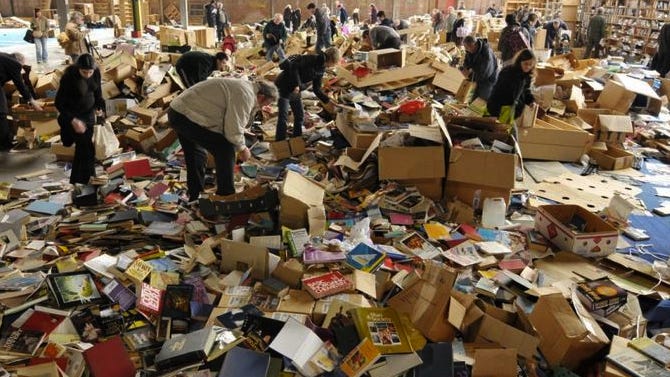
In the past, it seemed like serendipity to run across a book on a topic I’m interested in or by an author I’ve heard about, but today, it has become another acquisitive event, leading to confusion, as there are too many interesting or pressing subjects and too many authors to check out. This isn’t a complaint - it’s not a problem, exactly - but a sign that an adjustment is needed.
Reading books is a way for me to think. My reading life runs parallel and sometimes intersects with my writing life. It was alienating to feel this part of my life “sloppified,” so to speak. I’m figuring out how to be intentional and selective based on a clear understanding of what I need amid excess, which is probably what we all have to get better at, in many areas of life (what you spend your time on, who you spend your time with, where your money goes), given all we’re confronted with.
The good news is that anything is accessible now, in terms of what to read. And to be clear, I’m not saying having “too many books” is to be avoided, rather, that it’s worth investigating what you buy (or take for free), what you keep and why. What’s the difference between abundance and excess?
***
All this is a prelude to my annual reading round-up, which will be much shorter than usual. It was not a good year for me in terms of reading books, clearly, though I did manage to finish some. I’ll be writing about them in the next few weeks, and I look forward to the annual conversation!
For the love of book lists, the completist spirit, and full disclosure, I thought I’d start with a quick analysis of the books I didn’t manage to finish, because there were many of these. All of the false starts probably add up to several books!
Books I Didn’t Finish in 2025 but Intend to Return to Someday:
Moby-Dick, or The Whale by Herman Melville, read about 200 of 600 pages: This was a project undertaken during a road trip to New England over the summer. I hadn’t read Moby-Dick before. It was a lot of fun at first, but then I got home and it was not something I wanted to pick up before bed - it needs continuity and focused time.
The Haunted Looking Glass: Ghost Stories Selected and Illustrated by Edward Gorey (New York Review Books) (read 2 out of 12 stories): I love the art of Gorey and thought he would have great taste in ghost stories. I picked this up on a whim during one of the NYRB sales. I also wanted to read something spooky around Halloween. I did like the stories I read but got distracted by other books.
The Idiot by Elif Batuman (Penguin, 2017), read about 120 of 420 pages. A funny, rambling novel about a Turkish-American girl-woman attending Harvard. I might seek it out again. I got it from the library but just not something I was in the mood for at the time… Or maybe I won’t ever actually want to read about being a freshman at Harvard? I kind of don’t ever really want to hear about Harvard (I mean enough already, right?) and Harvard was definitely front and center in this one, not mere background. (Sorry Literature Supporter, I know you love this one!),
Past Tense: The Cocteau Diaries, Volume Two (1985), read about 40 of 366 pages. I should probably read more of Cocteau’s fiction/plays before reading his diaries, but these had a promising start. Cocteau comes off as a well-established artist with strong opinions and an interesting circle of friends and frenemies, a Paris-Provence life. I got this at the fantastic Diamond Hollow Books, in Andes, NY (in the Catskills), which is owned by one of the founders of Spoonbill & Sugartown in Brooklyn (a legendary bookstore in my mind). When I was buying this used copy, the owner, Miles, pointed out that on one side, the pages are stained with smoke, and showed me the initials “PS” in the upper righthand corner of the first page. This stands for Peter Schjeldahl, the late, wonderful art critic at The New Yorker. His library was damaged by smoke in an apartment fire, and his collection later ended up at the bookstore. I’m happy to know this story and to have his copy.
Pure Colour by Sheila Heti (FSG, 2022), read about 15 of 224 pages. I liked Heti’s other books, but this starts off in a mythological mode that gave me a feeling I was going to get annoyed. The book itself is so beautiful - gorgeous cover design, slim hardback, I don’t want to get rid of it. If you have read this and like it, please plead its case to me.
The Long Form by Kate Briggs (Dorothy, 2023), read about 20 pages of 448. Another impulse buy from an NYRB sale (Dorothy is a fabulous feminist imprint acquired by NYRB). This is a novel that definitely requires particular openness and focused time - a magnified, moment-to-moment view of a new mother and her baby, interspersed with the mother’s reading and thoughts on Henry Fielding’s Tom Jones. Not bad, but not a 2025 book for me.
Breasts and Eggs by Mieko Kawakami (Europa, 2020 (translated by Sam Bett and David Boyd)), read about 30 pages of 430 pages. I got this novel from the library and didn’t want to keep renewing it as I had several false starts. But I do intend to read this one. The title alone is so good - unsettling and evocative, yet simple and unforgettable. A novel about a family of women, by a young Japanese writer.
Books I Didn’t Finish and Shan’t Return to
All Things Are Too Small: Essays in Praise of Excess by Becca Rothfield (Metropolitan Books, 2024), read about 30 of 285 pages. I got this from the library based on a favorable review. Purportedly “a glorious call to throw off restraint and balance in favor of excess, abandon, and disproportion”, sounds good, right? But the essays seemed to yoke together disparate complaints to prove half-baked theories (e.g. Marie Kondo’s minimalism is a product of the same forces driving spare autofiction). Ambition gone wrong!
The Diaries: 1931-1965 by Dawn Powell (1995), read about 60 of 513 pages. I read an excerpt of these a long time ago (maybe in Harper’s) and became interested in Dawn Powell, but they didn’t hook me this time. She’s definitely a fascinating character, though, brave and resilient.
The Year in Writing and Not Writing
Not a lot of writing activity in 2025 given the state of mind touched on above, but I did have a few poems published in Action, Spectacle.
The first poem was originally called “Poem for Elon,” but I changed the title to the more obscure “Intake Manifold” after I learned this intriguing phrase when our car broke down (it’s an integral part of the engine). But now I think “Poem for Elon” is probably the better title…
In the criticism realm, I published a review of Marie-Helene Bertino’s short story collection Exit Zero in the Chicago Review of Books.
A note to subscribers: I will never charge for this newsletter, please disregard any requests to pledge that Substack might automatically insert into this message or elsewhere.
***
Up next: 2025 Reading Round-Up, Part I
A sad year indeed but reading provides a wonderful escape in my opinion. Can be so transporting away from worries and feelings of outrage and powerlessness!
Continue to always enjoy and respect your thoughtful and cogent comments, Meg!